The Parish Council Meeting scheduled for Thursday 5th September has had to be cancelled at short notice due to insufficient Councillors being available to be quorate… the next meeting is scheduled for Thursday 7th November… apologies for this.
Tewkesbury Borough Council votes to become North Gloucestershire Borough Council
Tewkesbury Borough Council has voted to change its name to North Gloucestershire Borough Council, following consultation with residents, businesses, town and parish councils, and other partners.
Electoral Register Annual Check
We are required by law to keep the register of eligible voters up to date. From August/September each year we contact every household to find out if the details on the electoral register are correct. This is known as the ‘annual canvass’. Being registered gives you the right to vote at elections and could also improve your credit rating or help you if you need to apply for credit.
We are sending email correspondence on Thursday 29 August to all electors who we hold an email address for, you must respond by using one of the below methods. If you do not respond by Friday 13 September a reminder letter will be sent in the post around the 16 September.
Parish Council Meeting
The next meeting of the Twigworth Parish Council will take place on: Thursday 5th September 2024 starting at 7pm – Down Hatherley Village Hall
All residents are welcomed to attend.


Councillor Resigns

Councillor Rick Harris and Chairman of the Twigworth Parish Council has resigned.
Rick had served as a Councillor member for some time and contributed immensely to our community, his experience will be greatly missed, we thank him for his service and wish him well for the future.
Further details on the due process will be provided as and when available.
Twigworth Green Development
(Full report can be viewed on TBC Planning by referencing 24/00122/CONDIS)
During 2020, Oxford Archaeology carried out an excavation immediately to the south of the village of Twigworth in Gloucestershire; the fieldwork was commissioned by RPS Group (formerly CgMs Heritage) on behalf of Bovis Homes Western.
Three main phases of activity were encountered. These dated to the middle–late Iron Age, the early Roman period (mid-/late 1st century AD) and the middle Roman period (2nd century AD).
Two pits containing late Neolithic/Beaker pottery represented some of the earliest activity on the site; at least 12 roundhouse gullies were revealed, together with a small square enclosure; these contained middle to late Iron Age pottery.
The Iron Age settlement was replaced during the early Roman period by two large square enclosures associated with trackways and wells or waterholes.
These were replaced in turn during the 2nd century AD by two further enclosures.
In addition, four inhumation burials were found, one of which cut into a roundhouse gully.
No evidence for activity dating after the 2nd century was found, apart from ridge-and-furrow cultivation, likely to be of medieval or early post-medieval date.
A large quantity of finds was collected, particularly Roman pottery and animal bone, together with personal items such as brooches and several querns and millstones.
It is probable that the evidence dating to the Iron Age related to a domestic settlement.
In contrast, the Roman-period activity had more of an agricultural focus. Well-preserved plant and insect remains were recovered from the wells or waterholes. These have the potential to provide considerable insight into the local landscape and economy during the Iron Age and Roman period.
This assessment presents the preliminary findings of the fieldwork, specifies what further post-excavation recording and analysis are required, and assesses the potential of the results to address research questions and contribute to a better understanding of the region’s Iron Age and Roman- period landscape.
A programme of analysis and publication is proposed.
Support for our armed forces
We are proud to support our armed forces community, as signatories of the Armed Forces Covenant and members of the Defence Employer Recognition Scheme (ERS).
This page outlines the main ways we show our appreciation and provides details of the support available to serving and ex forces personnel living in Tewkesbury Borough.

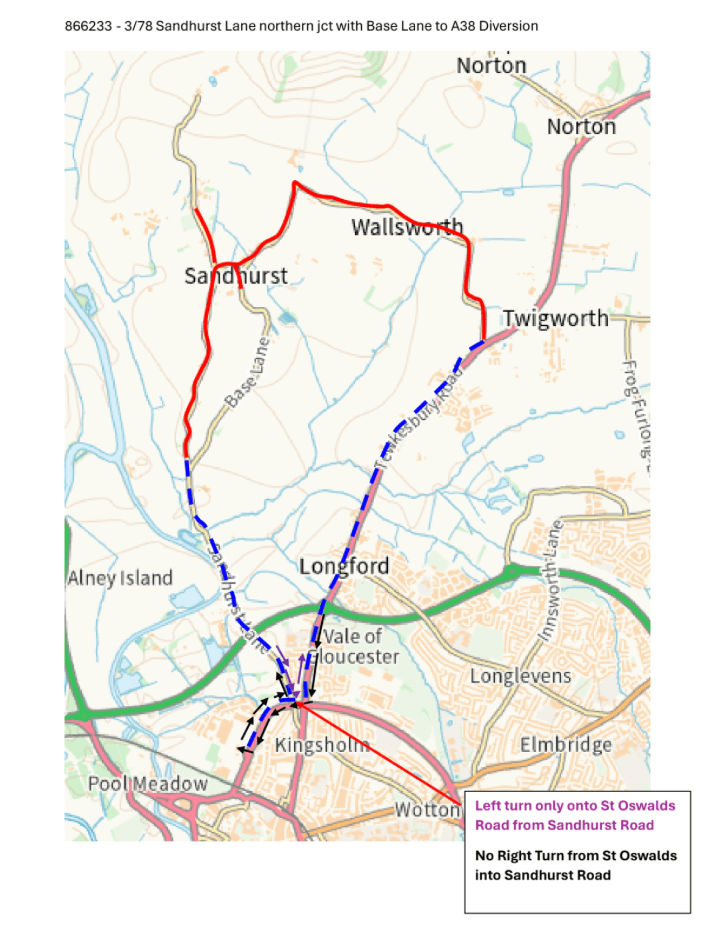
Base Lane/Sandhurst Lane, Sandhurst
Base Lane/Sandhurst Lane, Sandhurst will be closed (as per the attached plan) from 28/10/24 07.00 to 19/11/24 19.00.
This road closure is required by Gloucestershire Highways to carry out Carriageway Resurfacing works in this location. Emergency and Pedestrian access will be maintained throughout.
If you require any further information regarding this closure, please contact Gloucestershire Highways on 08000 514 514.
Greg Burford, GCC Roadspace Co-ordinator (Tewkesbury District Area)
 Twigworth Parish Council Gloucestershire